
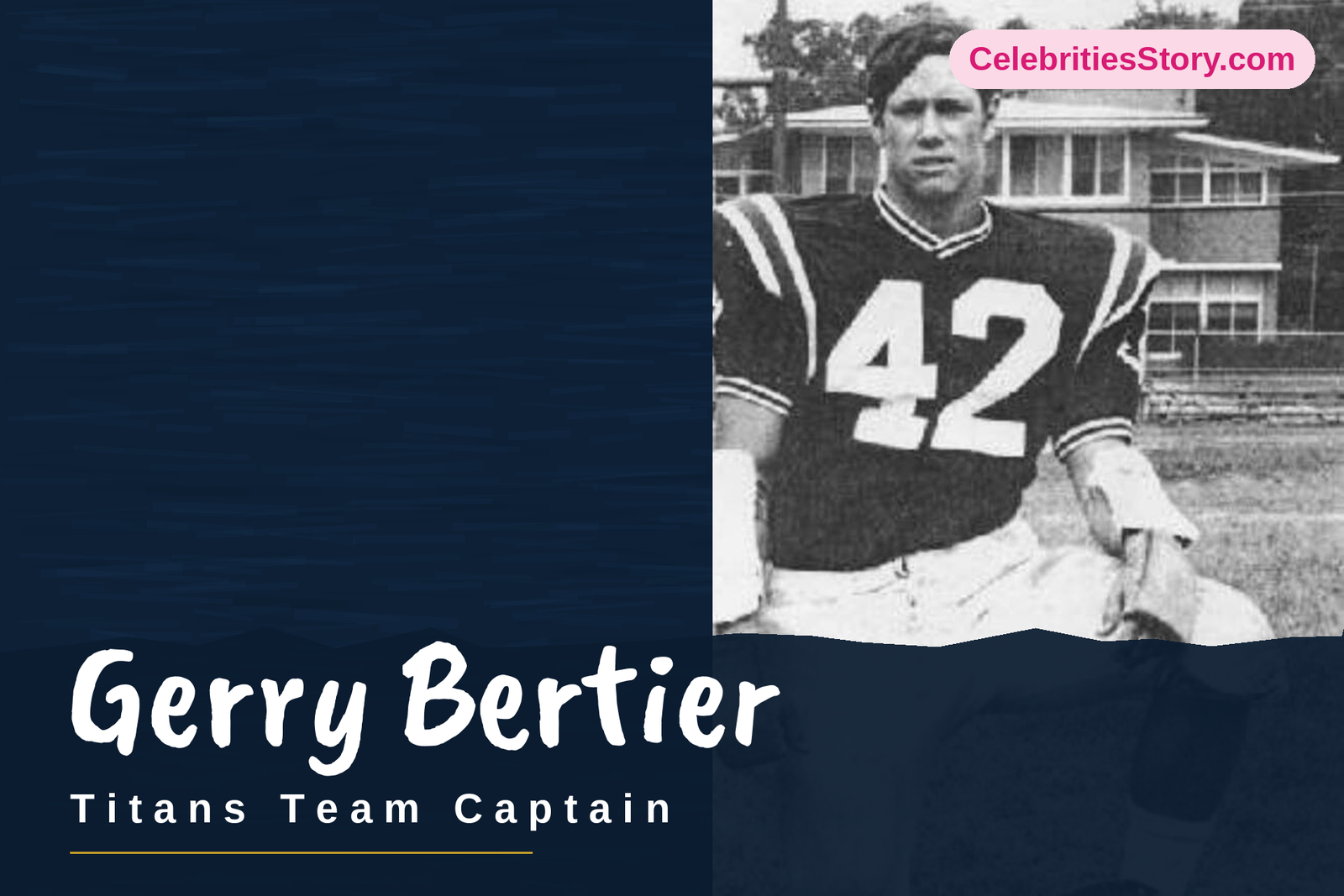
Gerry Bertier: Football Career, Accident, Family, Death & Real-Life Story

Gerry Bertier was a high school football captain whose name became known far beyond Alexandria, Virginia. As the defensive leader of the 1971 T. C. Williams Titans, he helped his team through a newly integrated season that ended with a state championship.
His story did not end on the field. Weeks after that title, a crash left him paralyzed, and he spent the next decade as a para-athlete and advocate.
This article separates the verified record from the film version, checking his dates, family, accident, death and legacy against published sources.
Quick Facts
| Detail | Information |
|---|---|
| Full Name | Gerry Bertier |
| Born | August 20, 1953 |
| Age at Death | 27 years old |
| Birthplace | Alexandria, Virginia, U.S. |
| Died | March 20, 1981, Charlottesville, Virginia, U.S. |
| Nationality | American |
| Profession | High school football player, Paralympian, advocate for disabled people |
| Position | Linebacker |
| Team | T. C. Williams Titans, No. 42 |
| High Schools | Hammond High School and T. C. Williams High School, Alexandria |
| Education | Northern Virginia Community College |
| Mother | Jean Bertier, later Jean Agnew |
| Sister | Becky Britt |
| Spouse / Partner | No marriage is documented in reliable published sources |
| Children | No children are documented in reliable published sources |
| Net Worth | No verified estimate from a major outlet; see Net Worth section below |
Who Was Gerry Bertier?
Gerry Bertier was born on August 20, 1953, in Alexandria, Virginia, according to Wikipedia’s summary of published sources. He grew up in Alexandria at a time when the city and its schools were changing fast.
Friends and family described him as friendly and goal-oriented. According to his sister, Becky Britt, he talked from childhood about wanting to win an Olympic gold medal.
He never played college football, because the accident happened just after high school. His reputation rests on one remarkable high school season and on what he did in the ten years that followed.
What Was Gerry Bertier’s Early Life and Family Like?
Gerry Bertier’s parents divorced when he was around eight years old, according to biographical sources. He was raised primarily by his mother, Jean.
His mother later remarried Robert Agnew. Her account, “Triumph Over Tragedy,” published as Jean Agnew, is a primary source for details of the 1971 accident.
His sister, Becky Britt, later became the keeper of his legacy and, in 2006, founded the foundation that bears his number. He was also the nephew of Howie Livingston, who had played in the NFL for Washington, according to Wikipedia.
No reliable source lists a wife or children for Gerry Bertier. Coverage focuses on his parents, sister, teammates and coaches.
How Did Gerry Bertier Start Playing Football?
Gerry Bertier began his high school career at Hammond High School in Alexandria. He joined the football team and quickly became the backbone of the defense.
As a sophomore, he was already the starting linebacker, according to the Mount Vernon Gazette account cited by Wikipedia, and played three seasons at Hammond.
In 1971, Alexandria consolidated Hammond, George Washington and T. C. Williams into a single T. C. Williams High School. That merger created a new team and immediate tension.
What Happened in Gerry Bertier’s 1971 Championship Season?
The 1971 season is the reason Gerry Bertier is remembered. T. C. Williams, under head coach Herman Boone, brought together players from schools that had been largely segregated.
As defensive captain, Gerry Bertier, along with teammate and defensive end Julius Campbell, helped hold the group together, according to published team histories. Their friendship, across racial lines at a difficult moment, became a central theme of later retellings.
On the field, there was little sign of division. The Titans finished 13-0, recorded nine shutouts and outscored opponents 357-45, according to Wikipedia’s summary of the season.
Gerry Bertier’s own numbers were reported as 142 tackles and 42 sacks for the season. He was named the team’s Defensive Most Valuable Player.
What Honors Did Gerry Bertier Receive?
The honors that followed the championship show how highly Gerry Bertier was rated as a schoolboy player. He was named National Prep School Football Player of the Year for 1971.
He also received First-team All-American, First-team All-State and First-team All-Region honors, according to his career record. T. C. Williams named him its Defensive Player of the Year.
As he prepared for the next level, he received football scholarship offers from prominent programs including Notre Dame and the University of Alabama, according to the Gazette account cited by Wikipedia. The accident ended those plans before he could accept and enroll.
Later, the school retired his No. 42 and inducted him into the T. C. Williams Athletic Hall of Fame. A gymnasium at what is now Alexandria City High School also bears his name.
What Happened in Gerry Bertier’s First Car Accident?
On December 11, 1971, Gerry Bertier attended a banquet honoring the undefeated Titans. After the banquet, he borrowed his mother’s Chevrolet Camaro.
On the drive, he lost control of the car and crashed. According to his mother’s account, he was stabilized and taken to surgery, where doctors tried to relieve pressure on his spine.
The treatment did not restore feeling. The crash left him paralyzed from the chest down, according to Wikipedia. Some secondary sources describe the injury as paralysis from the waist down, but the chest-down description is the one used in the main biographical summary.
The timing matters. In real life, the accident happened after the state championship game, on the night of the celebration banquet. It did not happen before the final, as the film later suggested.
How Did Gerry Bertier Rebuild His Life After the Accident?
Gerry Bertier attended Northern Virginia Community College after his injury. Contemporary reporting quoted after his death said he was working toward a degree in business there.
He also worked for Abbey Medical, selling medical equipment to disabled people, according to accounts based on the Washington Star report from March 1981. The job took him to wheelchair sporting events around the country.
Away from work, he visited spinal cord injury wards, helping new patients begin rehabilitation, according to the foundation history. He also helped organize a “Walk for Mankind” in Alexandria and spoke across the country about disabled rights, including building access.
Was Gerry Bertier a Paralympian?
Yes. After he recovered, Gerry Bertier returned to competitive sport in a wheelchair. He took part in wheelchair track and field, wheelchair basketball and United States Paralympic competition, according to published biographies.
Sources report that he set state and national records and won medals, including gold in shot put. Some profiles also credit him with gold in discus at the Wheelchair Olympics, though detailed results lists from that era are limited and accounts vary slightly.
For Bertier, the return had personal meaning. His sister said his childhood goal had always been an Olympic gold medal, and Paralympic competition gave it a new path. Coach Bill Yoast remained close to him and, according to one fact-check account, coached him toward a gold medal in shot put.
How Did Gerry Bertier Die?
Gerry Bertier died on March 20, 1981, in Charlottesville, Virginia, at the age of 27, according to published records.
He was returning home from a business trip, driving alone southbound in a 1980 Oldsmobile on Route 20. A northbound car crossed the center line and collided with his car, according to the Washington Star report summarized by Wikipedia.
He died afterwards from his injuries at the University of Virginia hospital. Reports based on contemporary coverage say he died about two hours after the crash.
A man from Schuyler, Virginia, was charged with manslaughter and driving under the influence of alcohol in connection with the accident, according to that same contemporary report.
Many 1971 Titans and their coaches attended his funeral, according to multiple retellings. He was reported to be buried at Mount Comfort Cemetery in Alexandria, a detail from secondary sites rather than a major obituary.
What Is True and What Was Changed in Remember the Titans?
In 2000, Disney released Remember the Titans, with Ryan Hurst playing Gerry Bertier. The film introduced his story to a worldwide audience and remains the main reason younger readers search for his name.
The broad outline is based on real events: the integration of T. C. Williams, the undefeated 1971 season, the leadership of Bertier and Julius Campbell, and Bertier’s paralysis and death ten years later.
Some details were changed for drama. As noted above, the paralyzing crash happened after the championship, not before it.
Wikipedia’s film section, citing ESPN and other fact-checks, also notes that the name of Bertier’s girlfriend in the film and the way his relationship with Campbell was presented were not completely factual. And his duties never included cutting a fellow player from the team, a scene involving a fictional player, because no such player existed on the real team.
His on-field portrayal, however, is described as almost entirely correct. He really was the dominant defensive captain the film shows.
Readers who like comparing a screen version with the real biography may also enjoy our profile of SZA and her music career and our explainer on Leo George Faulkner and the story behind Sleep Token’s Vessel, both of which separate public record from online speculation in a similar way.

What Is Gerry Bertier’s Net Worth?
There is no verified net worth figure for Gerry Bertier from Forbes, Celebrity Net Worth or another major estimator, and readers should treat numbers on low-quality listing sites with caution.
Some websites list figures ranging from around $1 million to $4 million, but those pages do not show a clear source, method or contemporary financial record to support the amount. For that reason, this article does not present any of them as fact.
The context also matters. He never signed a professional contract and worked in medical-equipment sales while studying, and no reliable record of his earnings has been published. His net worth is best described as not publicly verified.
What Is the Bertier #42 Foundation?
After Bertier died in 1981, his sister Becky Britt decided to continue his work helping survivors of spinal cord injuries. In 2006, she created the Bertier #42 Foundation, according to Virginia Commonwealth University.
The foundation raises money for spinal cord injury research, works with Virginia Commonwealth University and has hosted annual golf tournaments. The 2007 event reportedly raised approximately $20,000 for VCU’s Spinal Cord Injury Rehabilitation and Research Center, with support from members of the 1971 team.
Lesser-Known Facts About Gerry Bertier
- Gerry Bertier’s first name is pronounced with a hard G, like “Gary,” according to biographical sources.
- He wore No. 42 for T. C. Williams, and the school later retired that number.
- His dream as a child was not only football. His sister said he wanted an Olympic gold medal long before the Titans season.
- The Camaro he crashed in December 1971 belonged to his mother, according to his mother’s own account.
- He worked selling medical equipment to disabled people, a job that also let him travel to national wheelchair events.
- He spoke for better building access for disabled people at a time when accessibility law in the United States was still developing.
- The gymnasium at Alexandria City High School, formerly T. C. Williams, bears his name.
- The film moved his accident earlier in the season. In real life, he played in and won the state championship before the crash.
- His foundation was not created until 2006, 25 years after his death, by his sister to continue his hospital visiting work.
Frequently Asked Questions
When was Gerry Bertier born?
Gerry Bertier was born on August 20, 1953, in Alexandria, Virginia, according to published biographical records.
How old was Gerry Bertier when he died?
He was 27 years old. He died on March 20, 1981, seven months after his 27th birthday.
What position did Gerry Bertier play?
He played linebacker and was the defensive captain of the T. C. Williams Titans. He wore No. 42.
What team did Gerry Bertier play for?
He played for Hammond High School and then for the consolidated T. C. Williams High School in Alexandria, Virginia, winning the state championship in 1971.
How was Gerry Bertier paralyzed?
He was paralyzed in a car crash on December 11, 1971, after the team banquet. He lost control of his mother’s Chevrolet Camaro and suffered a spinal injury that left him paralyzed from the chest down.
How did Gerry Bertier die?
He died in a second car crash on March 20, 1981, on Route 20 in Charlottesville, Virginia. A car crossed the center line and hit his 1980 Oldsmobile, and he died later at the University of Virginia hospital, according to contemporary reporting.
Did Gerry Bertier play in the NFL or college football?
No. He received scholarship offers reported from Notre Dame and Alabama, but his paralyzing accident happened just after high school, before he could play college football.
Who played Gerry Bertier in Remember the Titans?
Actor Ryan Hurst played Gerry Bertier in the 2000 Disney film Remember the Titans.
Was Gerry Bertier married or did he have children?
No reliable published source documents a marriage or children for Gerry Bertier. Biographical and obituary coverage focuses on his mother, sister, teammates and coaches.
What is the Bertier #42 Foundation?
It is a foundation created by his family in 2006, led by his sister Becky Britt, to raise money for spinal cord injury research and to support work with Virginia Commonwealth University.
What was Gerry Bertier’s net worth?
No verified figure is available from a major source. Figures on some listing sites are presented without evidence and should be treated as unconfirmed estimates, not as documented fact.
Conclusion
Gerry Bertier lived only 27 years, but his story covers far more than a single season. He was the leader of an undefeated, newly integrated championship team, and then, for ten years, an athlete and advocate who refused to step away from public life.
The film made him famous. The verified record — records, hospital visits, speeches on access, and a foundation in his name — is more impressive. That is why his name remains on a gym in Alexandria, and why the 1971 Titans are still discussed for how their captain lived after football ended. Readers who enjoy sports biographies may also enjoy our profile of Charlie Battles.





2 Comments